|
Film for
the Minox
Minox film was originally defined as 1/4 the
width of 35mm film, 8.75mm, with an image size of
6.5mm x 9mm. When the image size was enlarged to
8mm x 11mm, the film width was increased to 9.4mm
(or 9.5mm depending on what you read).
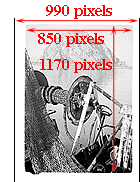
Factory loaded AgfaPan APX 25 was
scanned with a Nikon LS-1000 at 2700 ppi.
The edges of the film measured 990 pixels,
which translates to 9.31mm. The
image size on this film strip measured 850
pixels by 1170 pixels, which is 8x11mm,
plus-or-minus a pixel, confirming the
relative accuracy of the scan (assuming
that the image size is really 8x11mm).
There was a slight curl to the film which
was not eliminated.
|
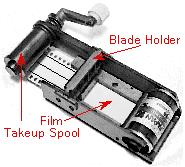
Performing the same test with
the Minox Film Slitter yields
strips 9.31mm wide. My
Plexiglas slitter yields strips
of 9.22mm and I have had
strips of 8.96mm work with
a narrow margin on one side of
the image. 8.9mm is probably a
theoretical minimum.
|
|
|
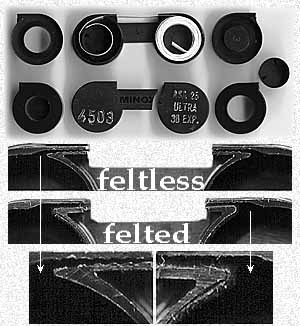 The early Minox
cassettes, first metal then plastic, used tape to
hold the caps in place, and had a felt-like
light-trap in the slots. The cassettes I have date
from the '70s and have snap caps which can be
opened by carefully pressing the case on the end
just below the cap. The early Minox
cassettes, first metal then plastic, used tape to
hold the caps in place, and had a felt-like
light-trap in the slots. The cassettes I have date
from the '70s and have snap caps which can be
opened by carefully pressing the case on the end
just below the cap.
|
ALERT!
All black plastic cassettes are
NOT alike! Although they
appear outwardly identical, some have
felt light traps and some do not. The
opening through which the film passes is
much narrower when the felt is not
present. If placed on the felted
cassettes, caps made for the
feltless cassettes will squeeze the
opening, and inhibit the movement of the
film. Trust me, you must
keep the caps with their proper cassettes.
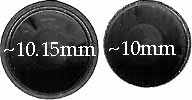
Furthermore, some of my '70s
feltless cassettes seem to have
film passages which have narrowed over
time and are nearly closed at the open end
(see picture). Although this is less of a
problem for the very thin Tech Pan, I have
discarded these in favor of the newer
felted cassettes. Some film types
(Fuji 800, Ilford XP2, etc.) are thicker
than others (Tech Pan, Kodak Royal Gold
25, Kodak PJM Ektapress, etc.). I prefer
the wider mouth of the felted
cassettes for the thicker film.
|
|
CAUTION. Be
careful not to overload the cassette.
The film must move freely in
the cassette. I have had good luck with 50
exposure rolls of Tech Pan, and the early
loads contained 50 exposures of various
films. My suggestion would be that when
the film is wound on the 1/4" dowel to
load into the supply-side chamber, room is
left for the film to "unwind" somewhat
when the dowel is removed. Experiment with
your film.
ALSO, be sure
the takeup spool is the correct size.
Take-up spools come in 15-exposure and
36-exposure sizes. They are easy to
distinguish, the 36-exposure size has a
very thin, sharp edged wall, whereas the
15-exposure spool has an obviously thick
wall.
|
|
|
|
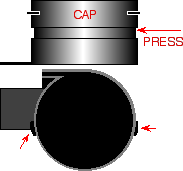
The early metal and plastic cassettes
had slip-on caps which were taped for
security. Later models provide a snap-on
cap which is held in place with 2 small
ridges which engage slots in the cap.
Gently pressing the cassette body with the
thumbnail just below the cap will release
the cap, permitting removal
|
|