|
Field
of View
If all of the images made with single focal
length cameras disappeared, the loss would be
catastrophic. Even with interchangeable lenses,
many of the greatest photographers have chosen a
"favorite" focal length, with which most of their
most notable images were made. The focal length(s)
of the lenses available to a photographer at any
given time greatly affect the selection and
management of the image. One either adapts the
image to the focal length or the focal length to
the scene. The ability to change the focal length,
either by changing lenses or the use of a zoom
lens, frees the photographer from a major
constraint, but it also complicates the image
management process by adding an additional element
to the selection process.
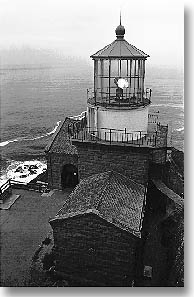
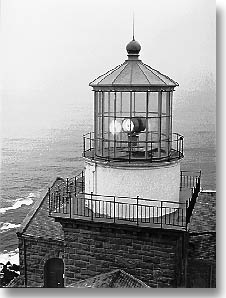
These scenes, both "full frame", were taken from
a narrow ridge which limited movement with
authority! Had the Minox been the sole
photographic instrument, the more moody and
representative image would have been missed. It is
illustrative of the fact that there is a proper
tool for every situation, and the Minox is not a
universal photographic instrument. In fact, access
is the controlling element here, prohibiting
establishment of the near-far relationship with the
Minox. Were it possible to move lower to include
the near roof, the Minox might have been useful.
|
35mm camera with 28mm lens
|
Minox 15mm lens (~48mm lens on a 35mm
camera)
|
|
|
Lens Focal Length
The "Normal" lens
|
Using the Leica Manual as a reference,
the focal length of a lens is defined as
the distance from the principle plane
(optical center) of a lens to the film
"when the lens is focused on a subject at
an infinite distance."
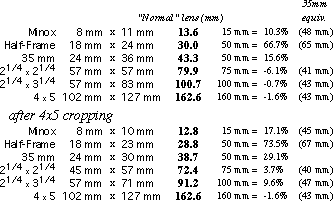
The focal length of a "normal" lens,
one which provides approximately the angle
of view of the human eye, is equal to the
diagonal of the negative. If less than the
entire negative is used during printing,
the calculations must reflect the new
effective negative size. The effect
can be best seen in the 6X6 cm (Rollei,
Hasselblad, etc.) data which reflects the
relatively severe (20%) cropping to a 4:5
ratio which leads to a reduction of the
effective "normal lens" from 79.9mm to
72.4mm. The result is to shift the
standard 75mm Rollei TLR lens from
slightly wide-angle to slightly long.
|
|
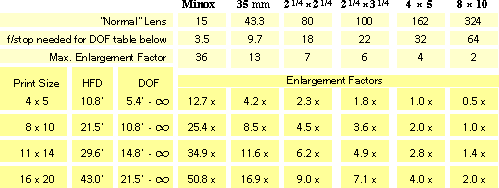
Depth of Field,
the near-far range of acceptable sharpness ON THE PRINT, depends on
- the focal length of the lens,
- the aperture used, and
- the enlargement factor of the print
Since larger format cameras require longer
lenses for a "normal" view, smaller apertures are
required to achieve a given depth of field. The
following table provides a glimpse of the
relationship between the three factors listed
above.
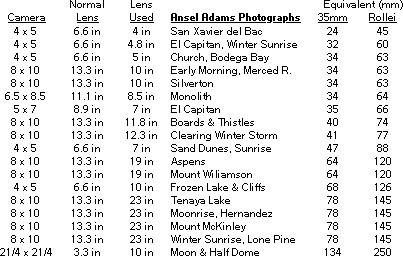
During the development of this thread, I became
curious about the focal length of the lenses used
for some of the memorable images made by Ansel
Adams. A random search of his The New Ansel
Adams Photography Series yielded the following
short list. Because various negative sizes are
involved, I included a list of "equivalent" 35mm
and 6x6cm lenses. To further complicate the issue,
I assumed the prints made from the 35mm and 6x6cm
negatives would be cropped to the 4x5 ratio. Please
do not nitpick the calculations, the object was to
provide a feel for the focal lengths used by one
photographer in a variety of situations. It was
interesting to me in that the range is relatively
limited, generally within a 2:1 range, and well
within the limits of today's high quality 35mm zoom
lenses. DO NOT interpret this as an endorsement for
the use of 35mm as a substitute for larger formats!
|