|
a bit about
Bits
The introduction of Hindu-Arabic numerals, the
concept of zero, and the notion of "place value"
led to our present notation system, the most common
example of which is our monetary system. The idea
that any value, no matter how large, could be
represented with a limited number of symbols, was a
monumental scientific breakthrough. We happen to
count by tens, with only ten symbols, in all
likelihood, as a result of having ten fingers!. One
of the great insights, the realization that it is
also possible to count by twos, with only two
symbols, opened the way for the development of the
electronic digital computer.
When I was teaching 7th grade mathematics, I
managed to irritate my charges by suggesting that
they didn't know how to add (or, for that matter,
subtract, multiply, or divide). You can imagine
what that did to 12 year-olds. To prove my point, I
suggested that, since counting probably arose from
tallying with the ten fingers, they might try those
same "simple" arithmetic tasks using the idea that
we had been created with only thumbs. The following
morning I was met by a room full of tired eyes and
satisfied grins.
Of course, what they discovered was that there
is nothing magic about ten, and that our arithmetic
works perfectly well whether we use a number system
based on ten fingers or two. An automobile odometer
will illustrate.
|
Imagine the odometer in your car with
only one wheel. since each wheel has ten
positions (including zero), after nine
miles, the wheel would return to zero and
our recent "Y2K" problem comes into focus.
|
 nine nine
|
|
By adding another wheel and advancing
it every time the one to its right returns
to zero, counting can continue - in this
case to 99.
The notion probably derives from the
inability to count past ten with the
fingers, and the need to put a rock in the
pocket when all of the fingers have been
used. Of course it was then evident that
when counting the rocks, (with the
fingers) that a "stick" needed to replace
each ten rocks, and so forth).
|

 ten ten
|
|
Adding wheels to the odometer increases
the maximum value that can be recorded. A
six-wheel DECIMAL
odometer can only record one less than a
million. Adding another wheel allows us to
continue. Thus it takes a "Seven-Figure"
number to record a million - and even more
|

 one million one million
|
|
When using a system based on two, we
have only two fingers, and two symbols 0
and 1, the odometer in your car with only
one wheel, can only represent zero and one
and cannot even count to two.
|
 one one
|
|
Adding a second wheel means we can now
increase our count to two and three.
|

two
|
|
Adding more wheels to our "Binary"
odometer increases the maximum value that
can be recorded, but at a MUCH slower rate since
each new wheel has a value only DOUBLE
that of its neighbor to the right - NOT
ten times as above with a decimal system.
Thus it takes a "Seven-Figure" number
to record a value of sixty-four, NOT a
million, as above
|
 sixty-three sixty-three
sixty-four
|
|
One must have lived through the era of
the Monroe mechanical calculator, with
whirring (ten toothed) wheels, to
appreciate the fundamental breakthrough
provided by the "discovery" that that
electricity can count with only two
symbols "1" and "0", or "on" and "off".
Suddenly mechanical machines could be
replaced by electric "machines". But
humans had to learn to count by twos as
well as tens.
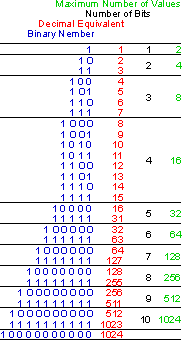
The table at the right illustrates the
relationship between some common values
and their binary representations. Notice
that seven can be represented with three
bits, fifteen with four bits, and 255 with
8 bits. So the values from 1 through 255
AND zero, representing 256 different
values, can be recorded with an 8 bit
binary number. If you use Photoshop, you
will recognize that black is represented
with a value of zero and white with 255.
These are the 256 shades of gray (or red,
green, or blue) that the normal "8-bit"
processing mode uses. Some limited
functions can be performed in "10-bit"
mode, and you can see that this will allow
1024 shades rather than 256. The term "Bit
Depth" is sometimes used to describe the
number of bits used to define these tonal
values.
If there are 256 shades possible with
an 8 bit number for each of Red, Green,
and Blue, the total is 24 - hence 24 bit
color and a possible 256 x 256 x 256
(16,777,216) colors. If 10 bit numbers are
used, the term 30 bit color is used, with
1024 shades each of red, green, and blue,
providing over a billion colors.
Early on it was observed that the
alphabet and punctuation could be
represented with a character set of less
than 256 symbols, so 8 bits became a sort
of a standard "data bunch", with the
creation of the ASCII
(character
set), and IBM's
EBCDIC
(character
set). IBM, when introducing their
System 370, decided "the 8-bit bunch"
needed a name and introduced the term
"byte". So much for history.
|
|
|