|
Negative Format
(Size and Shape)
Enlargement in this discussion refers to
linear enlargement. An 8" x 10" print from a
4" x 5" negative is described as "2x". Admittedly
it has four times the area, four
times the silver content, four times the
pixel count, AND four times the area NOT
covered by silver. Arguments can rage between the
usefulness of linear vs. areal measurement of
enlargement, but as a photographer, not a
physicist, and since linear measurement is the
basis for "lines per inch", "pixels per inch" and
"dots per inch", I will use "linear" measurement to
describe enlargement.
It is noteworthy that advances in film
technology, designed to produce APS results
comparable with that of the 35mm format, also mean
better film for the Minox!
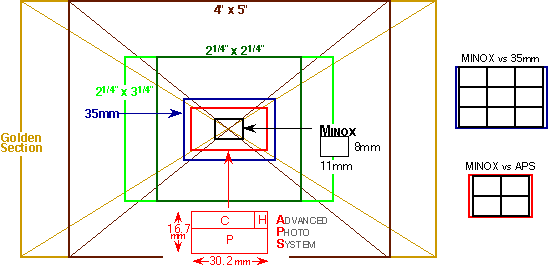
|
The
aspect ratio of negatives range
from
|
|
a square, with a
ratio of
|
|
1
|
|
through the 4:5
ratio of
|
|
1.25
|
|
to 35mm with a
ratio of
|
|
1.5
|
|
and finally
compared with the Golden Section
(see
below) at
|
|
1.618...
|
|
The aspect ratio of the final image has a
significant impact on the degree of enlargement
required. Higher aspect ratios favor the 35mm, APS,
and panorama formats, while lower ratios favor
"medium format" square negatives. Since each image
has its own "best" shape, which rarely matches the
shape of the negative, comparisons of one format
with another are risky.
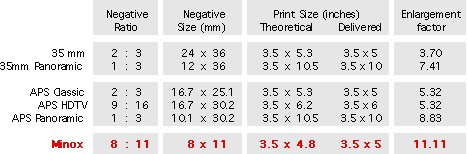
The following table shows various formats with
the enlargement factor necessary to produce prints
3.5 inch high. Some loss of data in the
final print is always present when producing
standardized print sizes. It is worthwhile noting
that the APS "Panoramic" format requires nearly as
much enlargement as the Minox format!
the Golden Section
|
|
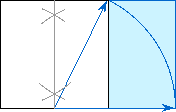
The Golden Rectangle is a
figure possessing the dimensions
of the Golden Section, in which
the ratio of the smaller element
(blue rectangle) to the larger
(white square) is the same as the
ratio of the larger (white
square) to the whole. It turns
out to be about 1:1.618 and can
be calculated using the Fibonacci
Series.
|
|
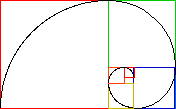
It is noteworthy that the blue
area is also a Golden Rectangle,
and if a square is added to each
succeeding Golden Rectangle the
figure below appears.
|
|
|
|
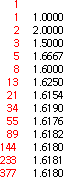
The arrival of the computer
made great sport of Number Theory
exercises, and the Fibonacci
Series was a favorite. It is
generated by supplying the first
2 elements, both "ones", then by
successively adding the latest
element to its predecessor to
provide the next.
|
|
|
If an arc is inscribed in each square,
as shown at the left,, the spiral
resembles the familiar seashell,
illustrating one application of the
relationship to nature.
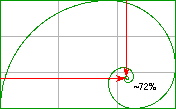
If the process is continued, the point
of convergence for the spiral approaches a
point near 72% and leads me to wonder if
this might be the origin of the
Compositional Rule of 1/3s.
|
|
|
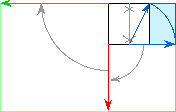
Once a Golden Rectangle has been
constructed (top left drawing), additional
Golden Rectangles may be constructed by
merely swinging the long dimension 90
degrees to describe a new rectangle. By so
doing, a spiral can be drawn, growing
infinitely larger rather than infinitely
smaller as in the drawing above.
|
For an exhaustive discussion of this topic, an
internet search for either "golden section" or "
fibonacci series" will yield rich resources.
|