|
Although experiments and development began
before World War I, the spring of 1925 saw the
introduction of the Leica 35mm "double frame"
camera. Using readily available movie film with
twice the image size of a normal movie frame, it
began a revolution in photography. During the same
period "single frame" cameras brought the
convenience of inexpensive, multiple exposure, roll
film cameras to the general public. The Ansco Memo
was one of these. The image size has returned in
the form of the new APS "C" format. Oh, well.
|
The Ansco Memo camera is a single
frame, fixed focus, 35mm camera, which,
held normally, takes landscape oriented
images. It is a leather covered, wooden
box, in which the film is advanced by
pushing down on a lever in the back of the
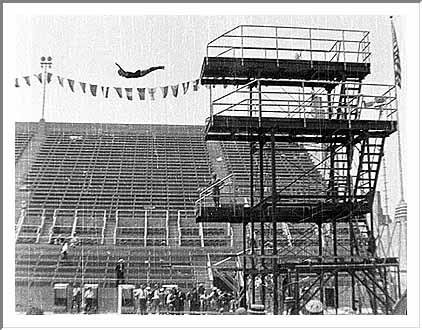
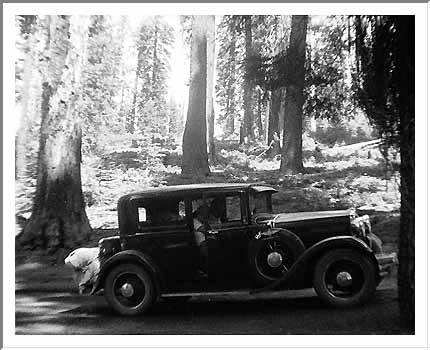
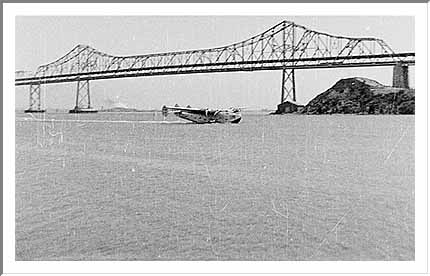
camera. Many of my junior and senior high
school negatives, the China Clipper, and
those from the top of Half Dome and George
Washington's head, were made with this
camera. The Canadian patent date on the
back is 1929. I am having it restored.
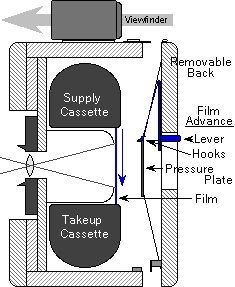
Film is
housed in a reloadable cassette resting in
the top chamber. To load, film is pulled
down and inserted into an identical lower
cassette and the camera back closed and
locked. Film is advanced by a double tooth mechanism
moved by a rod extending through the back
of the camera. In effect it is a
one-frame-at-a-time movie camera.
|
|
|
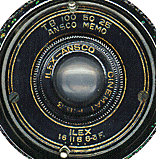
The lens is an Ilex-Ansco Cinemat
F:6.3. There is no focal length shown.
Normal would be in the 30mm range. Four
settings, f/6.3, 8, 11, and 16 are
provided with shutter speeds of T, B,
1/100, 1/50, and 1/25. Fixed focus at 15
feet ! Using the old "f/16 Rule" this
would limit use to ASA 100 film in bright
sunlight. All that could be expected in
1929.
For a 6x8 print, depth of field is from
8' at f/6.3 and from 3' at f/16. For a
16x20 print the near point is 20' at f/6.3
and 8' at f/16.
|
|
|
It is interesting that the "old"
single-frame
motion picture format is almost
exactly the same as the "new" C format of the Advanced
Photo System (APS). And both
are very close to the classic 4x5
shape
|

|
|
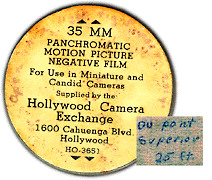
The advantage of the Ansco Memo was the
simple cassette which made loading from
bulk film easy and inexpensive. Scraps
from motion picture studios were packaged
in cans, similar to the one pictured, and
provided as an inexhaustible supply at
"the right price". In this case the type
of film was written on a piece of
"adhesive tape" and stuck to the bottom.
It is still there.
|
|
The following prints are from negatives that
have, for 60 some odd years, been curled in
cardboard tubes, as was the custom in the '30s. I
have found no satisfactory way to flatten the film,
especially since it is the old nitrate material.
Due to the storage and handling, small scratches
now appear as vertical streaks.
Click on thumbnail for full size
image
|