|
Some Thoughts
on Negative
Development
Development of films designed for a normal
pictorial characteristic curve, should begin with
the manufacturer's recommendation. Most microfilms
do not fall in that category and require modified
development schemes to achieve the full grayscale
associated with pictorial photography. Although I
have had excellent results with Kodak's recommended
Technidol developers for Tech Pan, I have found
Rodinal with sodium sulfite provides me with more
control and much shorter development times. Since
Rodinal is a reasonably active developer and will
produce VERY contrasty results with normal
development, higher than normal dilutions and
limited agitation, are needed to produce a normal
contrast index.
The traditional spiral developing tank in which
developer flows through narrow passages between
layers of film creates serious problems for high
energy developers when limited agitation and/or
high dilution is used to control contrast. Special
care is required with the agitation pattern,
especially with 35mm film to avoid streaks from
developer swirling through the sprocket holes.
Several solutions have been proposed for a 35mm
developing tank. The simplest, the "golf tube",
proposed a number of years ago by an author to whom
I wish I could give credit, is inexpensive and
works quite well. The only disadvantage of the
"golf tube" is the need to work in the dark because
of the absence of a light trap.
Kodak is quite specific in their directions
about the agitation method to be used with
Technidol - different for the solid version than
for the liquid. Both involve carefully lowering the
loaded reel into the developer rather than pouring
the developer into the loaded tank.
|
A 35mm technique
which has, for me, provided the best
results with the traditional spiral tank,
was suggested by Bill
Hoy of Bedford County, VA.
- Use a tank at least twice the size
needed for the number of reels you plan
to develop.
- Fill the extra space with empty
reels, placing the film at the bottom
of the tank.
- Pour in just enough developer to
cover the film, then simply invert the
tank at the specified interval,
draining the developer completely from
the film.
- After five seconds, reinvert the
tank, reimmersing the film.
|
The developer volume I use results from noticing
that Minox rolls
developed in a 250cc tank looked much
better than 35mm rolls developed in the same tank.
I concluded that the actual amount of developing
agent was a factor in the degree of reduction of
silver halides. Negatives developed with too much
developer, regardless of dilution seemed to have a
better tonal distribution. I chose as a
minimum, the amount of developer in a 1:25
dilution in a 250cc tank, for a 36 exposure 35mm
roll of film. Thus, for such a roll, 10 cc of
Rodinal concentrate should be present in the tank,
regardless of dilution. A Minox roll, with
approximately 1/10 the exposed area, would require
1cc. In practice, I use less (6.5cc) for 35mm and
more (2.5cc) for Minox. The Minox negatives still
look better! Remember that these are MY results, with MY equipment, and MY procedures, AND
MY EXPECTATIONS. Your results WILL be different.
I generally develop film with either Rodinal or
PMK Pyro, each of which produces negatives
expressively and physically different from the
other. So, with the variables of scene luminance
and film selection, as well as choices of
developer, dilution, and development time, the
possibilities are endless - and that's what makes
it FUN!
|
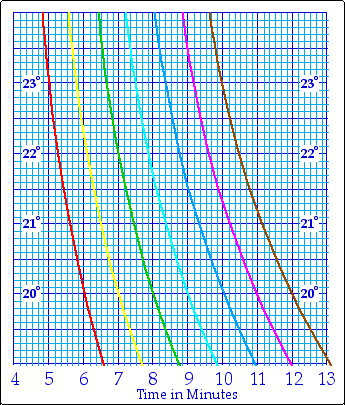
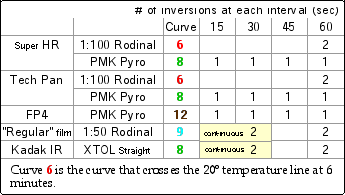
The chart and table are the ones I am
currently using. For PMK Pyro, I use the
agitation scheme recommended by Gordon
Hutchings, with only a single invert for
Tech Pan and Super HR
Agitation for 1:50 Rodinal follows
Agfa's directions on the Rodinal package.
The addition of infrared film to the
mix resulted in the inclusion of XTOL and
the time and agitation scheme from the
Kodak website. When exposing according to
the "f/16 Rule" using ASA 60 and the
Rollei red filter, this time and agitation
are excellent for me.
|
|
|
|
|
My
Rodinal Development
System
|
|
The description below is based
on the exposure of Technical Pan
film at a personal EI of ASA 25 -
Using an EI of 25, a Zone I
exposure will, with the following
processing, produce 0.1 density
above film base plus fog. IN MY
DARKROOM! Yours WILL vary!
A
bit of History - Credit where
credit is due!
I use Rodinal diluted 1:100
with a solution made with 56g of
sodium sulfite (anhydrous) per
liter of distilled water (one
LEVEL teaspoon of sodium sulfite
is approximately 7 grams). The
use of "anhydrous" sodium sulfite
is important because it assures
the correct amount of the
compound per unit of weight.
I usually mix a gallon at a
time and keep it under the
counter with a jug of plain water
for a 1 minute presoak. Both
solutions are thus at the same
temperature which I use to
determine the development time.
Currently, for N (normal)
development, I use the equivalent
of a 6 minute total time at 20
deg. C.
I presoak Tech Pan for 1.5
minutes in distilled water of the
same temperature as the
developer. I don't remember why a
minute and a half, something in
the distant past, but it seems to
provide a more even development.
It probably also lowers the
contrast a bit since it takes
time for the developer to
displace the water in the
emulsion.
I consider pouring the
developer into the tank (already
loaded with film) to be an
agitation cycle, so carefully put
sown the tank without further
agitation. The remaining
agitation is provided at 1 minute
intervals with Bill Hoy's method
described above. With these short
development times, both the
agitation scheme and interval
have a major influence on
negative contrast and density
Because the limited agitation
contributes to the lowering of
negative contrast, it is the
periods between agitation
(similar to "water bath"
development procedures) that
supply the build-up of shadow
detail. My best results are
obtained near 20 deg C, both the
time AND agitation interval being
critical to the shape of the
curve. I have never tried
temperatures less than 20 deg.
and have read somewhere that the
characteristics of developers
significantly change with lowered
temperatures. Perhaps someone
near the arctic circle can
contribute advice here.
|
|
|
PMK
Pyro Developer
|
|
Rodinal has been my developer
of choice for years. It replaced
a magic brew of the distant past,
"Perfection", which made
enchanted images with Kodak High
Contrast Copy Film (SO 5069). I
have not seen negatives, or
prints, with that velvet
sharpness and tonality since
their demise - until now. The
first film I have found of the
caliber of 5069 is Fiji Super HR
(about the same speed - ASA 3-6?)
developed with PMK Pyro.
Of course Pyro is not new,
having been one of the first
developing agents used. I have
used ABC Pyro (Edward Weston's
favorite) but never with small
negatives. I have, for years,
thought about trying Pyro as a
tool to tame the extreme contrast
of the super fine, high contrast,
films I like, but Pyro has NOT
had a reputation for fine grain.
I finally got around to it and am
now lamenting the wasted years.
The chemistry and Gordon
Hutching's book "The Book of
Pyro" are available from the
Photographers'
Formulary
The credit here goes to Gordon
Hutchings. It is a one-shot
developer, and the best results
are obtained by following HIS
directions. If it is as good for
me as I suspect it is, he
deserves my praise and gratitude.
If you are going to try this, buy
his book!
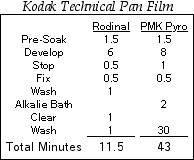 The only disadvantages
I have found so far are the time
necessary to develop a roll, and
the inability to intensify
individual roll-film frames with
selenium toner. Negative toning
with Kodak Rapid Selenium toner
is an excellent way to adjust the
contrast of individual frames of
roll film. With Kodak Tech Pan
developed in Rodinal, I have
achieved an N+2 increase in the
slope of the characteristic
curve. So far, I see very little
density increase with selenium,
FP4, and PMK, a confirmation of
Mr. Hutchings observations. The only disadvantages
I have found so far are the time
necessary to develop a roll, and
the inability to intensify
individual roll-film frames with
selenium toner. Negative toning
with Kodak Rapid Selenium toner
is an excellent way to adjust the
contrast of individual frames of
roll film. With Kodak Tech Pan
developed in Rodinal, I have
achieved an N+2 increase in the
slope of the characteristic
curve. So far, I see very little
density increase with selenium,
FP4, and PMK, a confirmation of
Mr. Hutchings observations.
I can tell you that it is
possible to get a good print from
a negative that looks TERRIBLE!
Also the look of the negative is
not necessarily an indication of
the appearance of the final
print. This is just the beginning
but I have the best prints I have
had from the Minox in years! But
be sure that this is NOT a
cookbook solution. It is an
experimenter's delight with what
I think is a worthwhile payoff.
For my
critical Minox work, I use
Fuji Super HR developed with
PMK!
|
Oliver Pyper
writes from Berlin:
- Tech Pan film, 25
ASA
- 100 ccm, PMK
developer in beaker,
- Minox developing
tank
- 6 minutes at 20
deg C.
- Presoak 1 min
with water and
photoflo
- Empty presoak
solution
- Add PMK solution
until the tank is
filled
- For agitation,
every minute (takes
about 8 seconds)
- Pour out about
20 ccm of the
developer from the
tank into the
beaker,
- then fill up
the tank again
from the beaker.
|
|
|

|
I put
this label on all of my bottles
of PMK
It can also
apparently be absorbed through
the skin.One should scrupulously
follow the safety directions
provided with the
materials.
|
|
|