|
Depth of
FieldDepth of Field is the total
distance, on either side of the point of focus,
which , when viewed from an appropriate distance,
APPEARS sharp in the final
print.
|
CIRCLES of CONFUSION
or Fooling the Eye
|
The New Leica Manual , Morgan &
Lester, 1951, states that the average eye, at a
viewing distance of 10 inches, can distinguish
individual lines when they are no less than about
1/100 inch apart. Thus, in the final print
viewed from a distance of 10 inches, "any
detail 1/100 inch in size or smaller will be
acceptably sharp." This observation forms the basis
for the calculation of most depth of field tables.
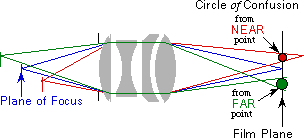 BUT! A lens
focuses at precisely ONE distance. Everything on
either side of that distance is out of focus,
PERIOD! BUT! A lens
focuses at precisely ONE distance. Everything on
either side of that distance is out of focus,
PERIOD!
- Points more distant than the plane of focus
are resolved as points in front of the
film, becoming fuzzy circles by the time they
reach the film.
- Points closer to the camera would be
resolved as points behind the film, so
they are also fuzzy circles when they reach the
film.
These fuzzy circles are called CIRCLES OF CONFUSION. Unless
various degrees of sharpness are used intentionally
as part of the image, it is the task of the
photographer to make the print appear as if the
lens is focused over a wide range from near to far,
to make the circles of confusion as small as
possible. This "depth of field" can to some degree
be controlled.
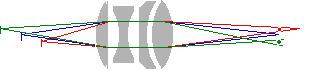 If the size
of the opening is reduced, narrowing the light
passage, the size of the CIRCLES OF
CONFUSION are reduced on the
negative. Thus, "stopping down" or making the
aperture smaller gives smaller circles of confusion
and extends the range of apparent sharpness.
Enlarging the negative enlarges the circles of
confusion, hence even smaller apertures are
required as the enlargement factor increases.
Remember we are striving for 1/100th inch on the
print! If the size
of the opening is reduced, narrowing the light
passage, the size of the CIRCLES OF
CONFUSION are reduced on the
negative. Thus, "stopping down" or making the
aperture smaller gives smaller circles of confusion
and extends the range of apparent sharpness.
Enlarging the negative enlarges the circles of
confusion, hence even smaller apertures are
required as the enlargement factor increases.
Remember we are striving for 1/100th inch on the
print!
BUT - reducing the aperture makes things worse
because light has a nasty habit of "bending" around
sharp edges at different rates depending on color,
and the iris is a circular sharp edge (see
Diffraction Limit of Sharpness below).
Factors affecting the depth of field are -
- focal length of the lens
- f/stop (aperture) selected
- size of the acceptable circle of confusion,
largely determined by the anticipated viewing
distance
- print enlargement factor
- the distance focused upon
REMEMBER - ALL calculations shown below MUST be
made using the same units, either millimeters OR
inches, not both. AND the result will be in the
units chosen.
HYPERFOCAL DISTANCE is the
distance focused upon which produces the greatest
depth of field. It is the nearest point which, when
focused upon, will preserve the required circle of
confusion at infinity. The near point of acceptable
sharpness will be halfway between the hyperfocal
distance and the camera. So, if the hyperfocal
distance is 40 feet, a range between 20 feet and
infinity will be acceptably sharp - FOR THE
SELECTED PRINT ENLARGEMENT FACTOR!

|
NEAR & FAR LIMITS of
ACCEPTABLE SHARPNESS
|
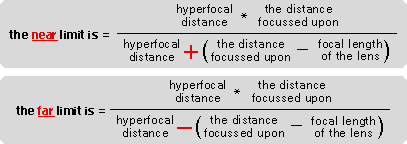
If the camera is focused at a point closer to the
camera than the hyperfocal distance, infinity will
no longer be "in focus" and there will be a FAR point as well as a NEAR point at which the circle of
confusion exceeds the desired size. As the point of
focus approaches the camera, the distance between
the NEAR and FAR limit of sharpness narrows and
we say the "depth of field" is reduced.
Since larger format cameras require longer
lenses for a "normal" view, smaller apertures are
required to achieve a given depth of field. The
following table provides a glimpse of the
relationship between the focal length, aperture,
and print size, using the focal length of a
"normal" lens for each of five formats. The f/stop
settings shown produce equivalent depths of field.
Thus, f/64 with a 324mm lens, and f/3.5 with a
Minox, yield the same depth of field!
"Group f/64" derived it's name from the need
for a very small apertures to achieve sharp images
with 8 x 10 cameras. Perhaps we should have a
"Group f/3.5".
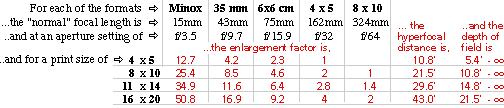
Note that doubling the linear dimensions of the
print also doubles the hyperfocal distance and the
point of nearest sharpness. If the camera is
focused at infinity, the depth of field would
extend only from the hyperfocal distance to
infinity - only half as far! To
achieve the maximum depth of field, you should,
whenever possible, focus on the hyperfocal
distance.
Depth of field scales engraved on lenses
assume some chosen enlargement factor. For example
an 8 x 10 inch print viewed from 10 inches for 35
mm cameras, and 4x5 inch prints for a Minox. It is
assumed that larger prints will be viewed from
greater distances.
The following tables can be used to assess the
depth of field for critical work in which the
potential print size is to be greater than the
nominal 4 x 5 range for which the depth of field
scale on the Minox is calibrated. They are also
theoretical in that they ignore the effects of
diffraction.
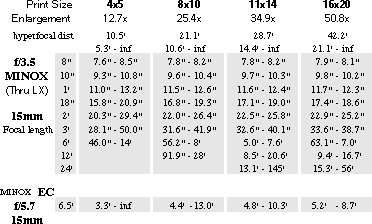
The Minox EC shares the 15 mm lens with its siblings. The lens
is stopped down to f/5.6 to increase the depth of
field. Focus adjustment is not available. With
these design characteristics, the hyperfocal
distance, for a 4" x 5" print, is
1.989 meters (6.53 feet). If the lens is
permanently focused at 2 meters, the EC table shows
the depth of field (range of acceptable sharpness)
for the various print sizes.
|
|
EC f / 5.6
Max. x = 22
|
LX f / 3.5
Max. x = 36
|
|
Enlargement
28x
Print 8.8"
x 12.6"
|
4.6' -
12'
|
12' -
inf
|
The EC and LX complement each other
almost precisely for prints in the 9 x 12
range. The depth of field figures indicate
that with one of each, no focusing would
be necessary from 4.6 feet.
|
Enlargement
21x
Print 6.6"
x 9.4"
|
4.1' -
16'
|
9' - inf
|
My favorite print size provides a 4 to
16 foot range for the EC and 9 feet to
infinity for the LX
|
Diffraction
Limit of Sharpness
A conflicting optical phenomenon is the tendency
of light to diffract. (change in direction and
intensity of a group of waves after passing by an
obstacle or through an aperture) . This
phenomenon can be witnessed in a stream where
ripples deform as they bend around a protruding
rock.
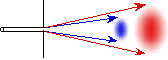 The amount of
diffraction is dependent on the wavelength, thus
varies over the visible spectrum from blue (400
nanometers) to red (700 nanometers). Smaller
apertures, and higher frequencies (toward red)
increase diffraction and actually decrease
resolution and limit the degree of enlargement. The amount of
diffraction is dependent on the wavelength, thus
varies over the visible spectrum from blue (400
nanometers) to red (700 nanometers). Smaller
apertures, and higher frequencies (toward red)
increase diffraction and actually decrease
resolution and limit the degree of enlargement.
A point of light, composed of various
wave-lengths, and greatly magnified, will appear as
a circle (Airy disc). Discussions of sharpness or
definition generally accept that a circle of 1/200
inch is perceived as "sharp' when viewed from
"reading distance".
|
Leica Manual gives the resolution of a
lens as:
"...the spacing between two points just
resolved is equal to the wavelength of the
light used for the measurement, multiplied
by the focal length of the lens divided by
the diameter." Since the "focal length
divided by the diameter" is equal to the
f-stop (f-number) tested, the equation is
reduced to wavelength * f-number.
So, for f/16 and blue
light
400 nanometers (blue light)
= (400 / 1000000) 0.0004
millimeters,
and
0.0004 * 16 (the f/stop) = 0.0064 ( the
spacing between two points just
resolved),
which is (1 / 0.0064) 156.25 lines per
millimeter
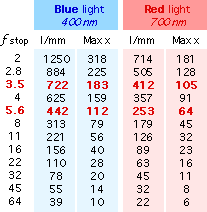
The table at the right shows the
resolving power of a lens and the largest
enlargement possible at specified f/stops,
for both BLUE (400 nanometers) and RED
light (700 nanometers), while retaining
100 lines/inch on the print. It is
clear that diffraction is NOT the limiting
factor to the enlargement of negatives
from either the traditional Minox (f/3.5)
or the EC (f/5.6).
|
|
Note: The table is based on a theoretical
calculation of the resolving power of a lens at a
specified aperture AND wave length. This is similar
to evaluating resolution at maximum contrast, which
rarely, if ever, occurs. The values in the table
should be at least halved for practical work, and
indeed I have seen data to that effect.
Lesson:
Use apertures small enough for the required depth
of field, but no smaller!
|