|
What is Film
Speed?
"Expose for the
shadows. Develop for the
highlights."
So, how much exposure is needed for the
"shadows"? ....It depends on the film
speed!
- Film "speed" depends on -
- the film's sensitivity to light intensity
and
color, AND
- to a lesser extent, the developer and
development procedure used.
- Your individual film "speed" may also be
affected by -
- the sensitivity, color response, and
accuracy of YOUR light meter,
- the quality and condition of your camera
lens, and
- the accuracy of the diaphragm and shutter
of your camera.
- whether you are "exposing for the
shadows" or using an auto-exposure camera,
gray card, incident light meter, etc.
- The film's characteristic curve or
"personality".
This is not intended as a full discussion of the
topic and primary references
should be consulted for complete understanding. I
have found Fred Picker's Zone VI Workshop
especially helpful in clearly outlining the steps
necessary to find (1) your personal film speed, and
(2) your "normal" film development time. Both are
very helpful and will ultimately save a lot of time
and money!
Finding your individual film speed (often called
"exposure index" or EI) for a film-developer
combination is a little like finding the "home" key
on a typewriter, or "middle C" on a piano. It gives
you a reference around which you can maneuver.
|
Kodak Publication No. F-5, KODAK
Professional Black-and-White Films
states that "..densities less than about
0.10 density units greater than gross fog
level usually print as black." This gives
rise to the notion that the part of the
negative which is to print darkest (other
than pure black) in the print, should have
a density of 0.1 above film-base plus fog
(fb+f), or in Zone System terms, ..enough
exposure to provide a Zone I density of
0.1 above fb+f. This is the Zone System
equivalent of "Expose for the shadows" in
the the ageless rule that heads this page.
|
Since exposure meters are supposed to interpret
what they read as middle gray (Zone V), a Zone I
exposure can be made by metering any uniform
surface and providing 4 stops less exposure.
To determine one's own film speed rating for any
film-development combination, it is necessary only
to ...
- Meter a uniform surface using your best
estimate (or manufacturer's rating) of the film
speed.
- Starting with the meter's recommendation
(Zone V), make a series of exposures, reducing
the exposure one stop per exposure for at least
six frames. I like to put a Zone V exposure at
the end to mark the end of the blank frames and
double-check the Zone V value.

- Develop the film according to the procedure
you are testing.
- There should be frames with no density other
than fb+f (film base plus fog), followed by a
frame in which additional density is clearly
identifiable. Theoretically, this frame should
have a density of 0.1 above fb+f, but in the
absence of a densitometer, your guess is
probably adequate.

- If the frame four stops from the Zone V
frame is too light (or clear), your speed (ASA)
setting is too high (you think your film is
faster than it is).
- If your "Zone I" frame is too dark and/or
there is density in the lighter frame next to
it, your film speed may be set too low and you
are getting more exposure than you need.
If further adjustment is needed, you may either
repeat the process with a new estimated film speed,
or estimate how much you would have to change your
estimated film speed to give the fourth (Zone I)
frame a density of 0.1.
|
It is an hour after sunrise. The sky
has light clouds with a little blue sky.
The sun is hidden behind a cloud. With a
Pentax Digital Spot Meter, the clouds read
EV 151/3 - 161/3 while the ground
under the edge of the deck reads 61/3. That is a 10 stop
range, in subdued light! If you desire
tonal separation in the clouds AND
definition in the leaves on the ground,
you need a film that can record more than
10 stops in a reasonably linear way.
Interestingly, in bright afternoon
sunlight, the range between bright cumulus
clouds and forest shade is about the same,
from 7 - 171/3.
|
|
|
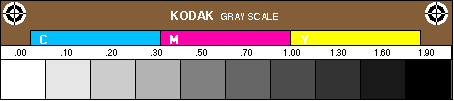
Photographing a Kodak Gray Scale in
either sun or shade exposes the film in
only about a 5 stop range. This is
adequate for short scale color reversal
films like Kodachrome, but color negative
and black-and-white films typically have a
much longer scale and exceed the range of
light reflected from the Gray Scale. If
you want your negative to have both Zone I
and Zone IX exposures, a single photograph
of the Kodak Gray Scale won't do it.
Adding the exposures from BOTH sun and
shade does, however, approximate (EV 8 -
EV 171/3) the 9+
stop range of light available in a normal
outdoor scene.
|
|
|
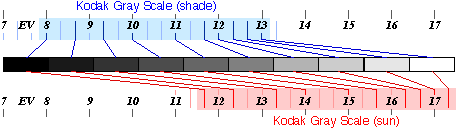
A Kodak Gray Scale was examined with a
Pentax Digital Spot Meter. Two sets of
readings, one in bright sun and the other
in shade, resulted in the EV readings
shown above. The slight difference in
range is probably due to the way light is
reflected from the glossy paper in diffuse
and direct light. The illustration above
shows that the black square is read by the
meter as EV 8 in the shade and EV 112/3 in the sun, while the
white square is read at EV 13 in shade and
EV 171/3 in the
sun.
Solutions have been suggested through
the years in which two cards are mounted,
one to the front surface of a box in
direct sunlight, and another in a recessed
shaded area inside the box. This allows a
single photograph to reproduce the full
range, but retains the problem of getting
uneven illumination to the "shaded" card,
since light inevitably "bounces around"
inside the box.
|
|