|
Personality
is Everything!
When you say "I like film X!", or "I don't like
film Y!", you are probably reacting to the
"personality" of the film and how it behaves in the
type of scene you are trying to interpret.
Although the personality of the film may
transcend film size and format, the criteria used
to select film for medium or large format cameras
does differ from those used to select film for a
35mm camera or Minox. Added to the complexity is
that the film of choice may not be available in the
desired format. When assessing a film's
applicability, one must consider the -
Your negative is rarely if ever seen, so unless
the goal is to demonstrate the virtues of specific
equipment or methods, neither equipment or method
is of interest to the viewer and should never be an
excuse for anything but the best result. Each film,
modified by the way it reacts to variations in
development, possesses a set of characteristics,
the sum of which form its personality. The shape of
the characteristic curve of a film is, along with
the film's speed, granularity, resolving power, and
spectral response, fixed by the makeup of the
emulsion. Of all of these characteristics, it is
the characteristic curve, the film's response to
variations in luminance, that is most influential
in how the final print will appear.
|
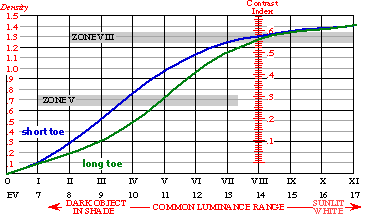
The illustration shows, two films with
the same luminance range, Zone I density
or "film speed", and when developed
properly, similar Zone VIII densities.
But, as the curves show, they react to the
intermediate light values in entirely
different ways. Short toe films react
quickly to differences in low light,
essentially building density quickly as
the light increases. Long toe films take
more energy to activate and show increased
density much more gradually. As the graph
illustrates, it takes considerably more
exposure to reach a given density with a
long toe film.
|
|
For example, if a density of 0.3 above film
base plus fog is needed to provide desired shadow
detail, the appropriate scene values may be placed
on Zone II with the short toe film, but must be
placed on Zone III with the other. In fact,
throughout much of the midtones range, more
exposure is required for the long toe film. BUT,
the real difference is in the visual differences in
both the negative and the final print. The short
toe film records better separation in the low
values, while better high value separation is
provided by the long toe film. The difference can
be dramatic and accounts for many of the expressed
preferences for one film over another. In reality,
each has a place in the photographer's bag.
Different Films,
Different
Developers!
I have experimented with a number of films, for
use with 120, 35mm, and Minox 8x11mm cameras. Each
has a distinct personality, with assets and
liabilities. Often the difference is purely
subjective and best described by "I like it!", or
"I don't like it." The acceptability of a given
film is dependent on a number of factors, perhaps
the most important of which are the photographers
vision and threshold of acceptability.
Remember that these are MY results, with MY equipment, and MY procedures, AND
MY EXPECTATIONS. Your results WILL be different.
I generally develop film with either Rodinal or
PMK Pyro, each of which produces negatives
expressively and physically different from the
other. So, with the variables of scene luminance
and film selection, as well as choices of
developer, dilution, and development time, the
possibilities are endless - and that's what makes
it FUN!
Several of the films popular in recent years for
subminiature photography -
- Kodak Technical
Pan Film (replaced High
Contrast Copy Film and Solar Flare Patrol Film)
- Excellent film, available in a variety of
formats. My favorite for Minox & 35mm,
and for 120 when fine detail is desired.
- Agfa Copex Rapid A.H.U.
PET 13 Microfilm
- FOR ME, produces
excellent results with old wood and textures,
although 2 stops slower and with more grain
than Tech Pan. Not in my current film
inventory.
- Fuji HS-U
Microfilm
- Only one stop slower than Tech Pan,
excellent sharpness and more uniform spectral
balance than Tech Pan. With Rodinal or PMK
and MY procedures,
displays considerably more grain than Tech
Pan. Not in my current film inventory.
- Fuji Super
HR
Microfilm ("New & Improved")
- Super fine grain and sharpness. Roughly
ASA 3, but provides excellent negatives when
exposed at 1/60 second in "f/16 Rule"
conditions.
|
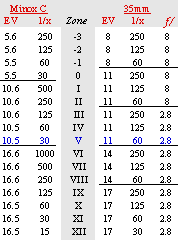
For the chart below, a Minox LX was
used to compare the four films. Successive
exposures were made providing the required
EV values with a Kodak Gray (& white)
Card in various positions in shade and
sunlight.
Corresponding shutter speeds were
chosen to produce Zone values from -3 to
XII for a nominal film speed of ASA 30, as
measured with my Pentax Digital
Spot Meter. Thus the Zone V Minox exposure
was made when the gray card was positioned
to give an EV value of 10.5 and the
shutter speed set at 1/30 second. The
rightmost part of the table is for
reference only and is my standard for
testing 35mm film in a Nikon FE
The four rolls were identically
developed at 20 deg. C., according to
my
standard Rodinal
procedure.
|
|
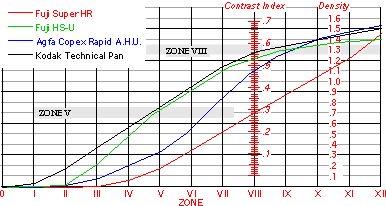
Since my definition of "film speed" (my EI,
"Exposure Index") is a density of 0.1 above film
base plus fog at Zone I, and since these
curves were gathered expecting the film had a speed
of ASA 30, a rough estimate of the actual film
speed (under MY conditions) can be had by shifting
the curve to the left until it contacts the
intersection of the Zone I vertical line and the
0.1 density horizontal line. Cutting the film speed
in half for each "Zone" the curve is shifted to the
left, I have an estimate of MY exposure index.
The table below shows the Exposure Value
(personal ASA) values I have established as a
result of "film speed" tests to establish a Zone I
density of 0.1 above film base plus fog. I find
that setting my automatic exposure Minox C at
double the "actual" speed provides the best overall
exposure in a variety of situations. Your values
WILL vary, depending on more
factors than I can name, and should be established
by you personally.
|
FILM
|
Actual "Zone I" EV
|
"Automatic Camera" ASA Setting
|
|
Tech Pan
|
25
|
50
|
|
Fuji HS-U
|
12
|
25
|
|
Agfa Copex Rapid
|
6
|
12
|
|
Fuji Super HR
|
3
|
6
|
The shapes of the curves provide information
about what to expect and, in my view, define the
"personalities" of the films. Tech Pan and Fuji
HS-U, for example, might provide similar densities
with scenes having limited shadow detail as at the
sea or airport. If the HS-U curve proves to be
accurate, the very short toe might have application
where low value local contrast is important. Prints
from Tech Pan and HS-U have a significantly
different appearance due, I suspect, to the
extended red sensitivity of Tech Pan.
Although I used Rodinal
and sodium sulfite for these comparisons, other
developers and/or other development procedures will
give different results.
|
|
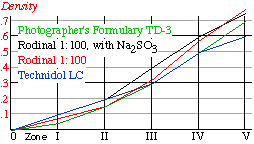
Four rolls of Kodak Tech Pan film, were
identically exposed using an ASA (ISO)
rating of 25. They were developed in four
different developers, using the
manufacturers recommendations for TD-3 and
Technidol LC, and my personal procedure
for Rodinal. The process was not
replicated, nor was an attempt made to
adjust the procedures to "match" the
curves at either Zone V or VIII. The only
concern was with the shape of the curve in
the area of the toe and how it affected
the point at which the curve crossed the
0.1 density line.
The actual film speed may be estimated
by judging how far its curve must be moved
right or left until it crosses the 0.1
density line. Thus the green curve must be
moved to the left approximately 2/3 of a
Zone, resulting an ASA 2/3 of a stop
slower than ASA 25 (ASA 15.7).
|
The effect of sodium sulfite on Rodinal is
nearly a half stop increase in film speed (defined
as requiring a film density of 0.1 above fb+f (film
base plus fog) at Zone I), although the densities
are similar in the area of Zone V. The difference
between the curves at Zones I, II, and III is
significant and, depending on the photographer's
understanding of the characteristic curve, is the
difference between the presence and absence of good
shadow detail. Since I have not attempted to adjust
development times and agitation routine, limited
assumptions about the value of the various
developers should be made. Suffice to say that the
shape of the curve can have a profound effect on
the metering and exposure of low values, and on the
amount of shadow detail and local contrast
captured.
Which one(s) do I like? All of them! Each has a
personality different from the others, providing a
choice of "canvas" on which to paint. But, if the
combinations of film and developer provide nearly
infinite variability, imagine the added
opportunities when including the combinations of
printing paper and developer!
|