 It has often been stated that there is no limit to the enlargement factor, since larger prints are viewed from greater distances. Fine, if there is a barrier preventing the viewer from approaching closer than the intended distance, or if the intent is obvious as in photo murals. When, for the intended viewing conditions, and audience, the print gives a hint of UNINTENDED lack of crispmess or granularity, or loses its maximum visual impact, the limit has been exceeded. Although we like to herald the virtues of the 8x11mm Minox, and it is indeed a magnificent machine, there is an enlargement factor for each negative at which the characteristics of the print will reduce the impact of the image. This break-up is generally signaled by an increase in "fuzziness" or an increased awareness of "granularity" or lack of smoothness. The former is the realm of the camera, the latter, of the film. The perception of these factors is influenced by the viewer's vision and experience. The contact print (enlargement factor = 1) provides print quality not possible with ANY degree of enlargement. Enlargement introduces image degradation, the degree depending on the AMOUNT of enlargement. So, all other factors being equal, prints made by enlarging various sized negatives TO THE SAME DEGREE, should exhibit the same quality characteristics. It is the AMOUNT of enlargement that counts! The Minox camera uses a special cartridge with an un-perforated strip of film approximately 9.4mm wide, as shown in the "contact proof" below. The size of the negative image is 8mm x 11mm. The full image shown is approximately a 14 x enlargement with the fishing boat "Kiaora" further enlarged. The fully enlarged boat is therefore a 120 x enlargement which would produce a 38" x 52" full print. This does not imply that I can make a 38" x 52" silver print directly from a Minox negative (the grain visible in the 16x20 inch print renders this image unacceptable at that size), only that the information to produce the image shown is present in this micro-negative. The 120 x enlargement is 400 pixels wide on your screen, and represents a 1.17mm wide portion of the 11mm negative. It clearly shows the silver grain clumps in the background hillside, the worst case, middle gray haze in a silver print. This image was made with a Minox IIIs and now discontinued Kodak High Contrast Copy Film (5069), a wonderful film with a nice spectral response and very fine grain ... about ASA 6. The camera was hand-held at probably 1/60th of a second. The image demonstrates the spectacular design characteristics, quality, and depth of field of this fine 1950s camera.  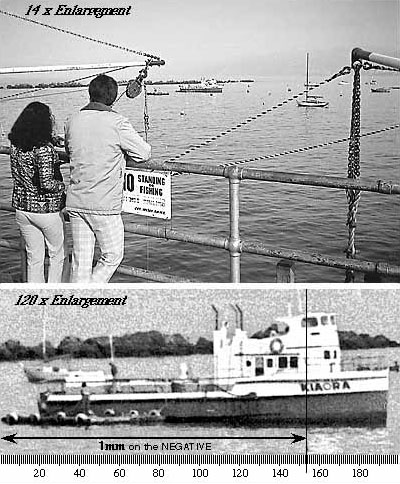 The scale below the 120 x enlargement may be used to appraise the resolving power of the camera/film combination. I have no data about the "official" resolving power of either film or camera. The 14 x enlargement was made directly from a negative scan. The 142 x enlargement was made from a "flatbed" scan of a 16 x 20 inch silver print made with an Omega B-22XL, Nikkor 28mm lens, and diffused light source. When the 16x20 inch print is scanned at 600 samples per inch, what are thought of as "grain clumps" (actually spaces between grain clumps on the film), are in the range of 8 pixels across. |