|
the Camera
Just as an 8 x 10 view camera
may not be the best choice for a yacht race, a
Minox is not the ideal choice for Yosemite murals.
The Minox, however, is unique in that it does
provide the best assurance that you will get a
quality image in either setting. It may be the only
camera which can always be
carried, provide "photo album" prints equal to any,
and, at the same time, make negatives for fine
exhibition quality prints.
The more one understands the Minox camera,
the greater must be the admiration for its inventor
Walter Zapp. Designed in the mid-thirties, built in
significant numbers in Riga, Latvia prior to WW II,
the camera has undergone a number of modifications
and technological enhancements through the years,
but the principles upon which the design rests
remain unchanged.
As a consequence of the short focal length and
"normal" field of view, the Minox can provide a
unique perspective, which is fully developed in an
article by Peter
Zimmerman.
The remarkable enlargeability of the Minox
negative is the result of ingenious design, fine
craftsmanship, and modern film technology.
|
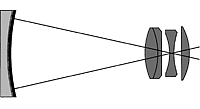
The lens of the 8x11mm Minox has a
focal length of 15mm ("normal" would be
13.6mm) so provides the same field of view
as a 49mm lens on a 35mm camera. Maximum
sharpness was achieved with the early
models, even at the fixed f/3.5 aperture,
by partially correcting the lens AND by
holding the film in a concave film gate.
The lens is recessed and protected behind
a permanent UV filter, thus has a
permanent "lens shade."
|
|
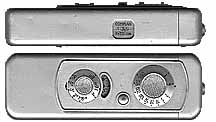
Closing the camera
- Opens the film gate & advances
the film.
- Advances the film frame counter.
- Locks the shutter release.
- Tension on shutter mechanism is
relaxed.
- Resets the built-in filters on
early models.
|
|
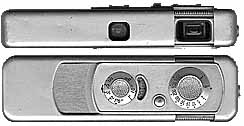
Opening the camera
- Exposes the lens window and
viewfinder.
- Closes the film gate, curving the
film into place.
- Cocks the shutter.
- Unlocks the shutter release.
|

|
Speed of the metal blade shutter,
located between the lens and the UV
shield, is controlled with a thumb-dial
which can be set to any speed between 1/2
and 1/1000 second, (T)ime or (B)ulb. The
special shutter blades operate like a
focal plane shutter except that the speed
is always the same, exposure being
determined by the release interval of the
second blade. This means that there is
never the distortion associated with
conventional focal plane shutters
operating at high speeds.
|
|
On early models the frame counter
extended to 50 exposures.
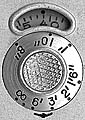
The distance dial allows you to focus
from 8 inches to infinity. A curved line
is engraved on the camera body to
represent the depth of field when the
desired distance is aligned with the
center dot. Since depth of field depends
on the degree of enlargement proposed,
refer to the discussion of depth
of field for critical work. The
engraving on the camera is probably
adequate for high quality 5" x 7" prints
The entire viewfinder is linked to the
distance dial, moving to align the image
seen by the viewfinder to that seen by the
lens, providing automatic parallax
compensation throughout the focusing
range.
|
|
In 1970 the "Complan"
lens, with the curved
film gate shown above,
was replaced with the
"Minox"
lens, and a flat film
plane.....................................Is there a
difference in
performance?
|
|
|
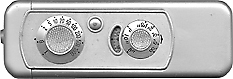
IIIs
|
15 x 27 x 80mm
|
1936 - 1969 "Complan"
lens
|
sn 58.500 - 147.494
|
|
|
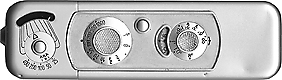
B
|
15 x 28 x 95mm
|
1958 - 1970 "Complan"
lens
1970 - 1972 "Minox" lens
|
sn 600.001 - 984.328
|
|
|
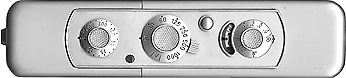
C
|
15 x 28 x 120mm
|
1969 - 1970 "Complan" lens
1970 - 1978 "Minox" lens
|
sn 2.300.101 - 2.473.694
|
|
|
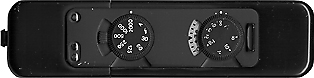
LX
series
|
15 x 28 x 108mm
|
1978 - Present "Minox" lens
|
sn 2.500.001 -
|
|
EC and ECX
feature
- 15mm, f/5.6
lens (stopped down
"Minox" lens)
- FIXED
FOCUS at 2
Meters
- Automatic
Exposure only
|
|
|
EC
ECX
|
15 x 30 x 80mm
|
1981 - Present
|
sn 2.700.001 -
|
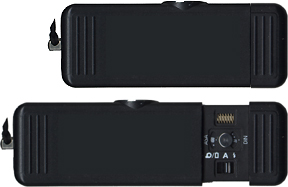
|
SHUTTER SPEEDS
Mechanical models have
continuously variable shutter
speeds
Electronic models use only the
nearest marked shutter
speed
|
|
|
|
T
|
B
|
2
|
5
|
10
|
15
|
20
|
30
|
50
|
60
|
100
|
125
|
200
|
250
|
500
|
1000
|
Auto
|
ASA
Range *
|
|
IIIs
|
Mechanical
|
x
|
x
|
x
|
x
|
x
|
-
|
x
|
-
|
x
|
-
|
x
|
-
|
x
|
-
|
x
|
x
|
|
|
|
B
|
Mechanical
|
x
|
x
|
x
|
x
|
x
|
-
|
x
|
-
|
x
|
-
|
x
|
-
|
x
|
-
|
x
|
x
|
|
|
|
C
|
Electronic
|
|
|
|
|
|
x
|
|
x
|
|
x
|
|
x
|
|
x
|
x
|
x
|
x
|
6-400
|
|
LX
series
|
Electronic
|
|
|
|
|
|
|
|
x
|
|
x
|
|
x
|
|
x
|
x
|
x
|
x
|
12-400
|
|
EC
ECX
|
Electronic
|
|
|
|
|
|
|
|
|
|
|
|
|
|
|
max.
|
|
x
|
25-400
|
* for Automatic Exposure
operation
|
|