|
Certainly the most significant part of the Minox
is the optical system. I say "system" because a
change in any part seems to diminish the
performance of the original ingenious design. The
notion that a camera can produce sharp images from
8 inches to infinity is by itself unique. The
ability to produce sharp images of objects in the
range of 6 feet to infinity adds icing to the cake.
Together, these two features make the Minox one of
the most useful cameras available. BUT - and it is
a big "but" - one must pay attention when focusing.
|
Several factors affect the
quality of the image.
|
1.
|
Distance of
NEAREST
object
from the camera,
Distance of
FARTHEST
object
from the camera,
|
|
2.
|
Accuracy of
focus
|
|
|
and
not the least important
-
|
|
3.
|
Amount of
enlargement of the final
print!
|
Each camera (Minox, Leica,
Nikon, Rollei) has an ASSUMED
enlargement factor for which the
depth-of-field marks are
inscribed. Reference to computed
tables, or the calculation of
Depth of Field tables will
reveal the print size upon which
the inscribed marks indicate a
satisfactory result. For the
Minox, the mark below the
focusing knob covers a distance
of approximately 7 feet to
infinity, which will yield a
"sharp" print of approximately
5x7 inches.
As the illustration shows, the
depth-of-field marked on the
camera body does not change,
representing smaller and smaller
image ranges as the focusing
distance decreases.
|
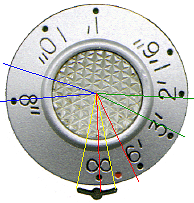 Fig. A
|
If a print of larger size is
desired, the range should be reduced.
Doubling the print size will cut the range
of sharpness in half. Thus, rather than a
range of from 7 feet to infinity, the
depth-of-field (range of apparent
sharpness in the print) will cover only 14
feet to infinity. This reduction in
depth-of-field applies to all focused
distances, thus reducing the closeup range
from 8 - 9 inches to 8 - 8.5 inches.
|
|
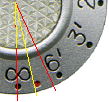 If the
small bar below the dial represents the
range of acceptable sharpness, and if the
infinity mark is placed in the center
thereof, then, in this illustration, the
range of acceptable sharpness extends from
approximately 12 feet to infinity. With
the dial set as shown in Fig. A above, the
range is considerably greater. In Fig. A,
the focus is set at the HYPERFOCAL distance, the
point at which, when focused, the lens
will provide the widest possible range of
acceptable sharpness INCLUDING infinity.
Except in cases where there is no near or
intermediate subject matter, it is of
little value to focus on infinity. BUT, it
is also useful to know where YOUR camera
is focused at the different settings, so
some testing might be worthwhile. If the
small bar below the dial represents the
range of acceptable sharpness, and if the
infinity mark is placed in the center
thereof, then, in this illustration, the
range of acceptable sharpness extends from
approximately 12 feet to infinity. With
the dial set as shown in Fig. A above, the
range is considerably greater. In Fig. A,
the focus is set at the HYPERFOCAL distance, the
point at which, when focused, the lens
will provide the widest possible range of
acceptable sharpness INCLUDING infinity.
Except in cases where there is no near or
intermediate subject matter, it is of
little value to focus on infinity. BUT, it
is also useful to know where YOUR camera
is focused at the different settings, so
some testing might be worthwhile.
|
Coupled with depth-of-field considerations
are those of Diffraction, which also causes
a blurring of the image. There is a maximum
enlargeability for each f/stop, after which
diffraction can cause as much damage as improper
focusing.
Maximum enlargeability for blue light at f/3.5
is 183, and 105 for red light. As these are
theoretical values, it is suggested that they be
halved, yielding 92 and 52. Since fuzzy red light
is not of much value even with sharp blue light, 52
is probably a good value to use. A 52x enlargement
from an 8mm x 11mm Minox negative yields a 16 x 23
inch print - far beyond the capability of most film
- AND the ability of the photographer to focus
accurately and control the other factors that
degrade image quality.
|