|
|
the Negative's
Response to Light
|
When viewing the real world of
reflected light we tend to overlook the
obvious that the brightest areas are those
reflecting the most energy. Early
photographic processes were forced to deal
with the fact that more light tended to
produce more deformation of whatever
sensitive material was chosen, lighter
areas in the scene producing the greatest
change, darker areas perhaps little or
none.
Black and white photographic emulsions
most typically contain a halide of silver.
A "halide" is a chemical compound of a
halogen (any of a group of five chemically
related nonmetallic elements including
fluorine, chlorine, bromine, iodine, and
astatine) with a more electropositive
element or group, in this case silver.
|
|
|
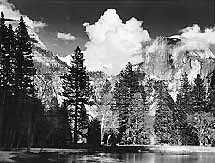
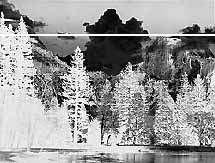
There are two steps in the making of a
negative, as represented by the thin slice
from the negative shown at the right.
- EXPOSURE. The useful property of
silver halide is that its state is
altered when subjected to light, IN DIRECT PROPORTION TO THE
AMOUNT OF LIGHT ENERGY
ABSORBED. This change is
not visible, and if film is examined
before and after exposure, little
change can be seen.

- DEVELOPMENT. Silver halide WHICH HAS BEEN ALTERED BY
CONTACT WITH LIGHT can be
reduced to pure silver if placed in
contact with specific chemicals
referred to as developing agents.

The activity of the developer and time
of development will determine how much
of the SENSITIZED halide will
be converted. less above, more
below.

After development, some of the
"altered" halide and all of the
unaltered silver halide remains in the
emulsion. It must be removed or the
negative will darken and deteriorate
over time. The removal of this
undeveloped material is accomplished
with fixing agents, usually sodium
thiosulfate (hypo) or ammonium
thiosulfate. The process is called
"fixing". The trick is to "fix" just
enough and not too much, as excessive
contact with fixers can begin to remove
some of the desirable silver material.
|
|
|
Discussion of the relationship between
exposure and negative density was
facilitated in 1890 by the research of
Hurter and Driffield and their expression
of the interaction in the form of a curve,
to become known as the H & D Curve, or
"characteristic curve".
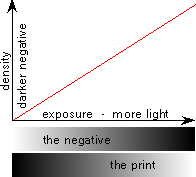
Ideally, a photographic emulsion will
react to light in a somewhat linear
fashion, more exposure, greater density.
Brighter parts of the scene provide more
light and activate more silver halide in
the emulsion.
|
|
|
|
|
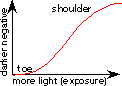
This linearity fails for two reasons.
- It takes a certain amount of light
energy to initiate the activation of
the photosensitive elements in the
emulsion. Thus the density rises
gradually at first in this area called
the TOE, finally
accelerating into the straight line
portion of the curve.
- With increasing exposure to light,
more silver halide is converted, until
it has no more sensitive material to
activate. At that point, increasing the
exposure does not increase the ultimate
density of the developed negative. This
"saturation" occurs gradually and
produces what is known as a SHOULDER. It can be
shown that even more exposure can
produce a reversal leading to less
density.
|
|
|
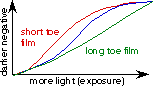
Each film emulsion reacts to light in a
special way. Some react more quickly to
low light than others creating a rather
abrupt initial rise in density or "short
toe". Others react more gradually to
increases in light and have what is called
a "long toe". Films with similar
sensitivities and ranges can have quite
different response curves requiring
dissimilar exposure and development
schemes. This discussion is further
expanded in the development section.
|
|
|
|
|
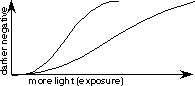
Another important factor is the range
of subject luminance that can be USEFULLY recorded. Long
range films, like Tri-X can continue to
build density over a long luminance range,
whereas short range films, Kodachrome,
Tech Pan, etc., saturate rather quickly
and tend to "block" at either end.
|
|
|
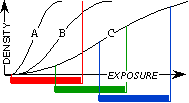
Determining the precise film speed,
coupled with precise exposure, is critical
when the range of light in the scene is
greater than the scale of the film (curve
A), or approaches the scale of the film
(curve B). If the colored bars represent
the scene's range of light, it can be seen
that ...
|
...a film with a scale of
curve A may not record the
scene's entire range of light.
One must find an exposure which
includes the best compromise and
most nearly expresses the
photographers vision.
Films with a scale of curve
B (covering the range of
light in the scene, but not much
more) require quite precise
exposure in order to not lose
data at either end.
With long scale films, the
issue is less demanding. A film
with curve C would allow a
variety of exposures (represented
by the red, green, and
blue
bars). The slope of curve C is
nearly the same for all three
examples, which might represent
using an ISO rating of 400, 200, and
100.
|
|
|
|
|